February 07, 2024
How Much Energy Does My Freezer Use?
There’s plenty of reasons why you would want and need your freezer to be running at optimum efficiency. Having a freezer that doesn’t use energy effectively is not only bad news for the environment, but for your utility bills too. It’s also very easy to forget that when you buy a new freezer, the price of the unit isn’t the only financial commitment you’re making. You’re also committing to how much it costs to run! In this guide, we’re going to look at how you can calculate the energy that your freezer uses. A freezer is a wise investment for your home, helping you save money on your food expenses when used properly. By calculating the energy consumption of different freezer models, you can ensure you get the best return on your investment.
Energy Labels
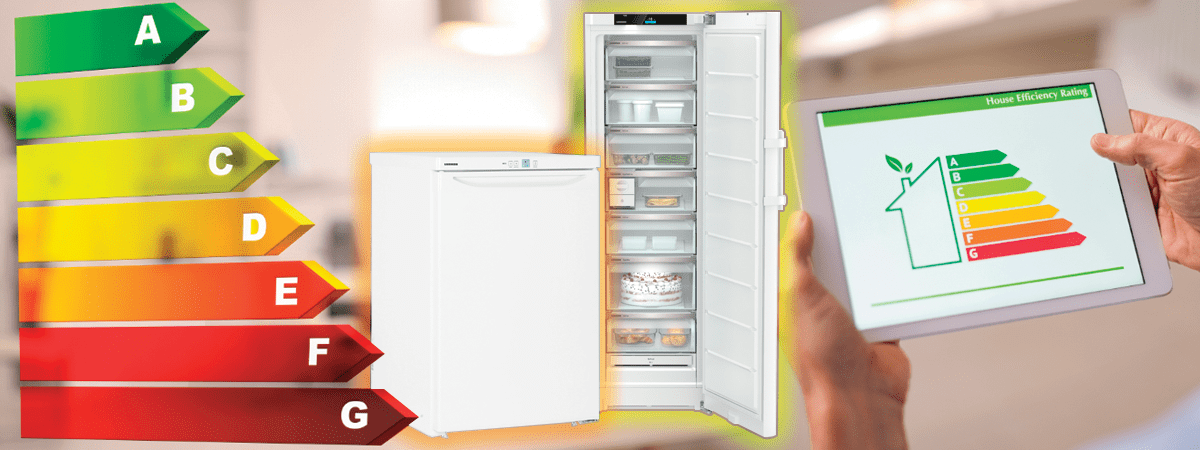
All freezers bought in the UK are legally required to display an energy label. Energy labels across various appliances are calculated using the same standardised tests. This ensures that you can easily compare any model on the market.
The energy label found on a freezer will display a calculated kWh/annum. This is the average amount of energy consumed per year by your freezer, according to their standardised test.
This result is extremely helpful when comparing models against each other. For example, you’re more likely to want to buy a 180kWh/annum freezer of the same specifications than a 200kWh/annum freezer. Lower energy consumption results in lower annual energy costs, as well as being better for the environment.
However, the calculated energy consumption per year will differ from actual average household use. This is because it doesn’t take into account factors such as:
Calculating Energy Usage
How to Calculate Energy Usage
The measurement used to calculate energy consumption for your freezer, or any other electrical appliance, is kilowatts per hour (kWh), which is equal to the wattage use divided by 1000.
kWh = Watts/1000
How to Calculate Daily Energy Use
To calculate your daily energy use, you first need to figure out how much wattage your freezer uses. There are two ways to calculate this, one being more accurate than the other.
The first way is to check the wattage listed on your freezer’s specifications. This is often found on a sticker on the bottom or back of your freezer. It may also be listed on the manufacturer’s website or within the model handbook. However, the wattage listed is the wattage output when your freezer is at full capacity. In order to get a more accurate calculation of your energy output using this wattage, we suggest that you divide this by 3.
Our example freezer has a listed wattage of 100. For a more accurate energy consumption result, we first divide this by 3.
100 W / 3 = 33.333 W
We now need to convert this into kWh. This is done by dividing the wattage by 1000.
33.333 W /1000 = 0.0333 kWh
This means that our example freezer uses 0.0333 kilowatts per hour. To calculate the daily energy usage, we just need to multiply by 24.
0.0333 kWh x 24 = 0.8 kWh per day
How to Calculate Longer Energy Use
How to Calculate Weekly Energy Use
To measure how much energy your freezer consumes per week, you first need to calculate how much energy is consumed daily. Look at the above calculation to learn how to do this.
Our example freezer uses 0.8 kWh per day. To find the average weekly energy consumption value, we multiply this number by 7.
0.8 kWh x 7 = 5.6 kWh per week
How to Calculate Monthly Energy Use
You can calculate your average monthly energy usage by multiplying your daily energy usage by 30. This is the average number of days in a month, and gives a more accurate result than calculating for a 28 day month (4 weeks).
You could also multiply your daily energy usage by the number of days within a specific month. This would give you a more accurate average consumption for that month.
For an average 30 day month energy usage estimate, multiply your daily energy consumption by 30.
0.8 kWh x 4 = 24 kWh per month
How to Calculate Yearly Energy Use
Finally, let’s calculate the average yearly energy consumption of your freezer.
To do this, multiply your daily energy consumption by 365. Our daily energy consumption gave us 0.8 kWh.
0.8 kWh x 365 = 292 kWh per year
How To Calculate The Cost Of Your Energy Usage
The final step is taking the cost of your electricity and multiplying that by your estimated energy usage. This will give you an estimate of how much your energy bill will be.
Let’s take the average price of a kWh in the UK, as of February 2024, which is about 29p per kWh. For a more accurate estimate for your household, please check your current energy tariff.
We have used the above energy consumption calculations to create estimates for energy costs.
Results based on a freezer with a listed specification of 100 W.
Keep Reading
Integrated Fridge Freezer Installation: Getting the Perfect Fit
17th June 2026
by Beckie Littlewood
What Temperature Should My Freezer Be?
24th April 2024
Fridge, Freezer or Fridge Freezer?
19th March 2024
The Best Freezer Brands
27th February 2024
Freezers: Buying Guide
20th February 2024

How to Defrost a Freezer
8th February 2024
How Much Energy Does My Freezer Use?
7th February 2024
FAQs
When using an average wattage of 100, a freezer will use 24 kWh per month. This equates to an average cost of £6.96 per month, as of 2024.
On average, a UK household will use a total of 10 kWh of electricity per day. The average amount of gas used per day is 35 kWh. That totals to 45 kWh energy usage per day. This will depend on the size of your home, home efficiency, and the time of year. Therefore, 40 kWh is within a normal daily energy consumption range.
A freezer will run more efficiently when full. This is because it doesn’t have to work as hard to cool down the internal temperature. It is therefore cheaper to run a freezer that is full.
Yes. Older freezers are much less energy efficient than new models. This means that older freezers will use more electricity, which will reflect on your energy bill.
No, in general it is not cheaper to run a separate fridge and freezer. Depending on the size and quality, one combined fridge freezer is cheaper to run than two.
Other than heating and cooling systems, water heaters, and lighting (which all use the most electricity), kitchen appliances use the most electricity. We recommend looking for energy efficient models to save you money on your kitchen appliance running costs.