

November 16, 2026
Dishwasher Energy Ratings Explained
Choosing a dishwasher is about more than finding a model that fits your kitchen or offers enough space for your dishes. Energy efficiency, water consumption, programme settings and everyday household habits can all influence how much a dishwasher costs to run over its lifetime. For some households, an energy efficient dishwasher can offer worthwhile long term savings. For others, a reliable mid range model with sensible water consumption and practical programmes may represent better value. Understanding dishwasher energy ratings makes it easier to compare models, identify genuinely efficient appliances and decide which features are worth paying extra for. This guide explains how dishwasher energy ratings work, what A rated dishwashers offer, how eco programmes affect running costs, why water consumption matters and how to choose the right appliance for your household. It also explores integrated dishwashers, family usage patterns and the factors to consider when following a dishwasher buying guide.
12 min read
What do dishwasher energy ratings actually mean?
If you’ve shopped for a dishwasher recently, you’ll probably have noticed the colourful energy label displayed on each appliance. In the UK, dishwashers are rated from A to G, with A being the most energy efficient and G the least efficient. The rating gives you an idea of how efficiently a dishwasher uses electricity under standardised testing conditions. It’s a useful starting point when comparing appliances, particularly if you’re trying to keep household energy bills under control.
The current A–G system replaced the older A+, A++ and A+++ labels in March 2021. The new scale uses tougher efficiency requirements, so an appliance that previously carried an A+++ rating won’t necessarily receive an A under the current system. It’s worth remembering this if you’re comparing an older dishwasher with a newer model.
| Energy rating | What it means |
|---|---|
| A | Highest energy efficiency |
| B | Very high energy efficiency |
| C | Good energy efficiency |
| D | Mid range efficiency |
| E | Lower energy efficiency |
| F | Low efficiency |
| G | Lowest energy efficiency |
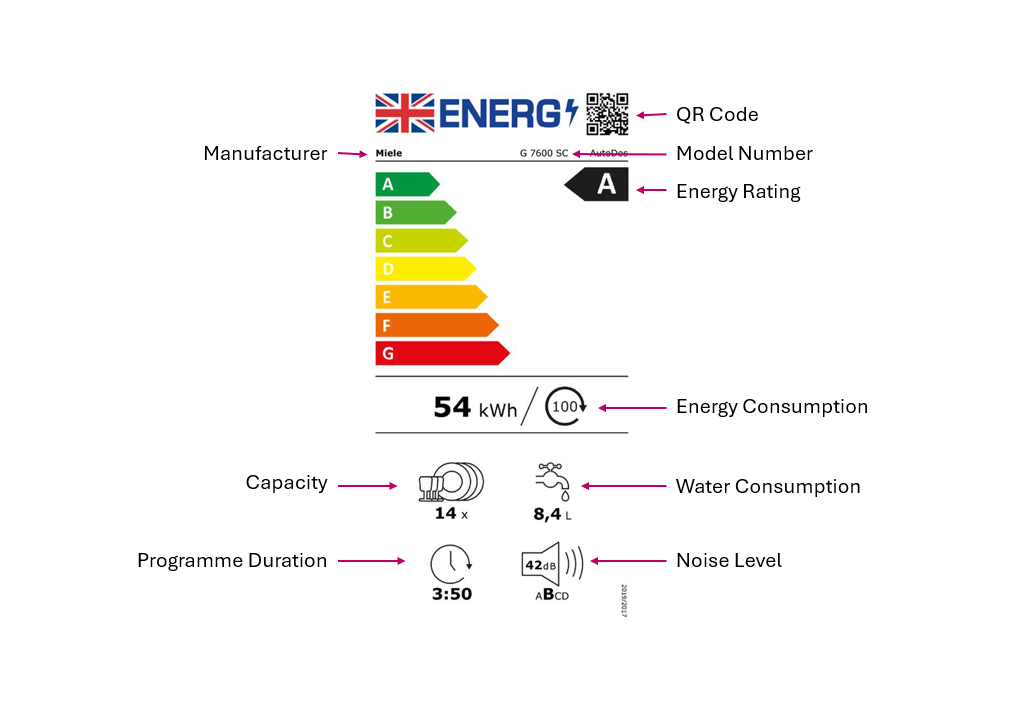
What information is shown on a dishwasher energy label?
The energy rating is important, but it’s not the only information worth checking. The label also tells you:
- Energy consumption: How many kilowatt-hours (kWh) the dishwasher uses over 100 eco cycles.
- Water consumption: How many litres of water it uses during one eco cycle.
- Capacity: How many standard place settings the appliance can accommodate.
- Programme duration: How long the eco programme takes to complete.
- Noise level: How much noise the dishwasher produces, shown in decibels (dB), alongside a separate A – D noise emission class.
These details make it easier to compare two dishwashers that might have similar energy ratings but different running costs and features.
Understanding kWh per 100 cycles
One of the most useful figures on the label is electricity consumption per 100 cycles. For example, imagine you’re comparing two dishwashers:
| Measurement | Dishwasher A | Dishwasher B |
|---|---|---|
| Energy rating | A | C |
| Energy per 100 cycles | 55 kWh | 75 kWh |
| Energy per cycle | 0.55 kWh | 0.75 kWh |
Dishwasher A uses 0.20 kWh less electricity per eco cycle. It might not sound like a huge difference, but it can add up when you’re using the appliance several times a week.
It’s also worth looking beyond the letter rating. Two A rated dishwashers won’t necessarily have identical energy consumption, so comparing the actual kWh figures is a much better way to understand potential running costs.
Are A rated dishwashers worth buying?
If you’re looking for an energy efficient appliance, an A rated dishwasher is an obvious place to start. These models sit at the top of the current energy efficiency scale and are designed to deliver effective cleaning while using comparatively little electricity and water.
For households that run their dishwasher regularly, choosing a more efficient model could help reduce energy bills over time.
There are a few reasons why A rated dishwashers are worth considering.
Lower electricity consumption
Heating water accounts for a significant part of the energy used during a dishwasher cycle. More efficient models use carefully controlled temperatures, improved water circulation and optimised wash programmes to reduce unnecessary energy consumption.
This is particularly useful if you run your dishwasher every day.
Less water used during washing
Energy efficient dishwashers often use less water, too. Modern appliances circulate and filter water throughout the wash rather than continually filling and emptying the machine. This helps them clean a full load using relatively small amounts of water.
If you have a water meter, this could be another reason to pay attention to efficiency when buying a new appliance.
Better long term value
A rated dishwashers can sometimes cost more to buy, but lower running costs may help make up for the initial difference. According to the Energy Saving Trust, an A rated dishwasher can save around £25 per year in Great Britain compared with the lowest rated dishwasher of the same size.
This is a useful benchmark, although the actual saving will depend on the appliances being compared and how often you use them. It’s also important to remember that the most expensive dishwasher isn’t automatically the most economical.
A well priced B rated model might offer better overall value if the difference in energy consumption is relatively small.
A rated vs B and C rated dishwashers
So, how much difference does the rating actually make? The following table gives you a simple way to think about the options.
| Rating | What to expect | Buying consideration |
|---|---|---|
| A | Highest efficiency class | Worth considering for frequent use |
| B | High efficiency | Could offer an excellent balance of price and performance |
| C | Good efficiency | May offer particularly good purchase value |
| D-G | Lower efficiency classes | We'd recommend comparing running costs carefully |
These are general buying considerations rather than guarantees about individual models. The important thing is to compare the actual energy consumption figures. For example, an A rated dishwasher using 55 kWh per 100 cycles will use less electricity on its eco programme than a C rated model using 75 kWh per 100 cycles.
However, the difference in purchase price also matters. If the A rated model costs considerably more, you need to work out whether the energy savings justify the extra investment.
How much does it cost to run a dishwasher?
This is probably one of the most useful things to understand before buying a new appliance. A dishwasher might look affordable in the shop, but it’s also worth thinking about what it will cost to use throughout the year.
Running costs depend on three main things:
- How much electricity the appliance uses.
- How frequently you run it.
- How much you pay for each unit of electricity.
The easiest way to estimate electricity costs is to use the energy consumption figure on the label.
Dishwasher running costs explained
Let’s compare three hypothetical dishwashers with different energy consumption figures. For this example, we’ll use an electricity rate of 26.32p per kWh, reflecting the Great Britain direct debit price cap rate for October to December 2026. Your own tariff may be different.
We’ll also assume each dishwasher is used five times a week, giving approximately 260 cycles a year.
| Measurement | Model A | Model B | Model C |
|---|---|---|---|
| Energy rating | A | B | C |
| kWh per 100 cycles | 55 | 70 | 85 |
| Energy per cycle | 0.55 kWh | 0.70 kWh | 0.85 kWh |
| Cost per eco cycle | 14.5p | 18.4p | 22.4p |
| Annual electricity cost | £37.64 | £47.90 | £58.17 |
Illustrative calculations based on eco-programme energy consumption, 260 cycles per year and an electricity rate of 26.32p/kWh. Actual running costs will vary.
The difference between Model A and Model C is approximately £20.53 per year. Over five years, that’s more than £100 in potential electricity savings. Of course, these figures only tell part of the story. The actual purchase price, water consumption and programmes you use should all be considered.

How often do you use your dishwasher?
Your household routine can make quite a difference to annual running costs. A dishwasher used three times a week will naturally consume less electricity over the year than one used every day.
Using a dishwasher that consumed 0.70 kWh per eco cycle as an example, here’s what you can expect to see annual from the electricity costs:
- 3 times a week (156 cycles per year) – £28.74
- 5 times a week (260 cycles per year) – £47.90
- Every day (365 cycles per year) – £67.30
Based on 26.32p/kWh and eco-programme consumption. Figures rounded.
This is why it’s worth thinking about your household’s actual usage rather than relying on the energy rating alone. A model that saves a few pence per cycle might be a worthwhile investment for a large family, but less important for a couple who only run their dishwasher two or three times a week.

Do dishwasher eco programmes really save money?
The eco programme is one of the most useful settings on a modern dishwasher, particularly if you’re trying to reduce electricity and water consumption. It’s also the programme used to calculate the energy efficiency figures displayed on the energy label.
Eco programmes are designed to clean normally soiled dishes while using energy and water efficiently. But there’s something that often surprises people: eco programmes usually take much longer than standard or quick wash settings.
Why does eco mode take so long?
It might seem logical that a shorter wash cycle would use less electricity. However, that’s not necessarily the case. Eco programmes generally use lower water temperatures and allow more time for soaking, detergent action and cleaning.
This means the dishwasher doesn’t need to rely on as much high temperature water to remove everyday food residue. The result is a longer cycle that can use less electricity and water.
Some eco programmes can take three or four hours, depending on the appliance. While that might seem excessive, the extra time is part of how the programme achieves its energy savings.
Eco wash vs quick wash
Quick wash programmes are designed for situations when you need clean dishes in a hurry. They can be useful for lightly soiled glasses, cups and plates, but they’re not automatically the cheapest option. In January 2026, Which? published findings from a snapshot test comparing eco, quick and main programmes on three dishwasher models. The results showed that quick wash used more energy and water than the main programme in the tested models, while eco mode was considerably cheaper to run.
Its estimated annual costs, based on five washes a week, were:
| Programme | Estimated annual cost |
|---|---|
| Main programme | £71.01 |
| Quick wash | £73.93 |
| Eco programme | £52.13 |
The figures came from the specific machines tested and shouldn’t be treated as guaranteed costs for every dishwasher. However, they demonstrate an important point: a shorter programme doesn’t necessarily mean a cheaper wash.
How much water does a dishwasher use?
Electricity isn’t the only running cost worth thinking about. Water consumption can also make a difference, particularly if you have a water meter.
Modern dishwashers are designed to clean a full load using relatively small amounts of water. They do this by circulating water through spray arms and filtering it during different stages of the programme. The amount used varies between models, so it’s worth checking the litres-per-cycle figure on the energy label.
Even a difference of a few litres per cycle can add up over a year. For example, choosing a dishwasher that uses 9 litres rather than 11 litres could save 520 litres of water annually if you run it five times a week.
Typical dishwasher water consumption
Some modern dishwashers use around 9 litres of water per eco cycle, although consumption varies depending on the model and its capacity. To see how this adds up, imagine you’re comparing three dishwashers:
| Water per cycle | Annual cycles | Annual water consumption |
|---|---|---|
| 8 litres | 260 | 2,080 litres |
| 9 litres | 260 | 2,340 litres |
| 11 litres | 260 | 2,860 litres |
| 12 litres | 260 | 3,120 litres |
Why water efficiency matters when choosing a dishwasher
It’s worth remembering that electricity and water consumption are separate measurements. A dishwasher with a particularly good energy rating won’t necessarily use the least water.
For example, one model might use 55 kWh per 100 cycles and 10 litres of water per wash, while another uses 60 kWh per 100 cycles and 8 litres. The first uses less electricity, but the second uses less water.
If you’re on a water meter, it’s worth considering both figures when comparing appliances.
Full size vs slimline dishwashers: Which is more efficient?
Dishwasher size is another important consideration, particularly if you’re trying to find the right balance between capacity and running costs.
Most household dishwashers fall into two main categories: full size and slimline.
Full size dishwashers
Full size dishwashers are generally around 60cm wide and commonly accommodate 12 – 16 place settings. They’re a popular choice for families and larger households because they offer plenty of room for plates, bowls, glasses, cutlery and cookware.
Advantages include:
- Greater internal capacity.
- More room for larger pans and dishes.
- Suitable for larger households.
- More flexibility when loading different types of crockery.
If you have the space and regularly generate enough washing-up for a full load, a full size dishwasher is often a sensible option.
Slimline dishwashers
Slimline dishwashers are usually around 45cm wide and commonly accommodate 9 – 10 place settings. They’re especially useful in smaller kitchens where a full size appliance simply won’t fit. They’re also worth considering for couples and smaller households that don’t regularly generate enough dishes to fill a larger machine.
However, there’s something important to know about their efficiency. Which? testing suggests that slimline models can use similar amounts of energy and water per cycle to full size models. Because they accommodate fewer dishes, they can be less economical per item washed. That doesn’t mean they’re a poor purchase. If you have limited space or generate fewer dishes, a slimline dishwasher could still be the most practical option.
How family usage patterns affect dishwasher running costs
One of the easiest things to overlook when buying a dishwasher is how your household actually uses it. A couple who cook occasionally will have very different requirements from a family with several children. The number of people in your home, your cooking habits and how often you entertain guests can all influence the capacity and efficiency you need.
Small households and couples
Smaller households may not generate enough washing up to justify a full size dishwasher every day. A slimline or compact model could be a better fit, particularly if kitchen space is limited. However, a full size model can still make sense if you cook regularly or prefer to collect dishes throughout the day and run one full load.
Useful features include half load settings, adjustable racks and flexible loading arrangements.
Families with children
Families often generate a surprising amount of washing up; Breakfast bowls, lunch containers, dinner plates, drinking glasses and cooking utensils can quickly fill a dishwasher. For these households, capacity becomes particularly important.
A full size model with adjustable racks and a dedicated cutlery tray can make everyday loading much easier. Features worth considering include:
- 13 – 16 place settings.
- Adjustable upper baskets.
- Folding plate supports.
- Efficient eco programmes.
- Delayed start settings.
- Flexible cutlery storage.
If you run your dishwasher every day, energy efficiency also becomes more important because small differences in consumption can add up over time.
Larger households
For larger families or busy households, a dishwasher may run once or even twice a day. In this situation, it’s worth looking more closely at the actual energy and water consumption figures. For example, a dishwasher using 0.20 kWh less per cycle would save:
- 3 cycles per week – 8.2kWh annual electricity saving
- 5 cycles per week – 14.3 kWh annual electricity saving
- 7 cycles per week – 19.1kWh annual electricity saving
The more frequently you use your dishwasher, the more important its efficiency becomes.
How to make your dishwasher more energy efficient
Even if you’ve bought a particularly efficient dishwasher, the way you use it can make a difference. Fortunately, there are a few simple habits that can help keep running costs under control.
- Use eco mode for everyday washing. It’s generally the most economical choice for normally soiled dishes.
- Run full loads. Try to make good use of the available capacity instead of repeatedly washing small quantities.
- Avoid pre-rinsing. Scrape leftover food into the bin rather than rinsing every plate under a running tap. Modern dishwashers are designed to handle ordinary food residue.
- Load dishes correctly. Make sure spray arms can rotate freely and water can reach all the items.
- Choose the right programme. There’s little point using an intensive cycle for lightly soiled cups and plates.
- Keep filters clean. Regularly cleaning the filters and spray arms helps maintain good cleaning performance.
- Use delayed start when it suits your tariff. If you have cheaper off peak electricity, scheduling a cycle during those hours could reduce the cost of running your appliance.
- Keep up with maintenance. Follow the manufacturer’s advice on dishwasher salt, rinse aid and cleaning.
These are small changes, but together they can help you get more from your appliance.
FAQs: Dishwasher Energy Ratings Explained
A is the highest energy efficiency rating on the current A – G scale. If you want to minimise electricity consumption, an A rated dishwasher is a good place to start. However, compare the actual kWh per 100 cycles and purchase price before deciding which appliance offers the best value.
They can be, particularly if you use your dishwasher frequently. However, the amount you save depends on the difference in energy consumption and how often you run the machine. A cheaper B rated model could be a better investment if the running cost difference is relatively small.
It varies depending on the appliance and programme. The energy label shows electricity consumption per 100 eco cycles. Divide this figure by 100 to estimate the electricity used per cycle. For example, a dishwasher using 70 kWh per 100 cycles consumes 0.70 kWh per eco cycle.
Generally, eco mode is designed to use less energy and water than quick wash. Quick programmes are shorter, but they may use higher temperatures and more intensive heating to clean dishes quickly. Always check your manufacturer’s programme information, as consumption varies between models.
Eco programmes generally use lower temperatures and longer washing stages to achieve effective cleaning while reducing energy and water consumption. The longer duration is part of how the programme achieves its efficiency.
No. Integrated dishwashers aren’t inherently more expensive to run than freestanding models. Their running costs depend on the appliance’s energy and water consumption, programme selection and frequency of use.
A full size dishwasher can offer better efficiency per item washed because it accommodates more dishes. However, slimline models can be a sensible choice for smaller households and kitchens where space is limited. The best option depends on how much washing up you generate and whether you can regularly fill the appliance.
Using an efficient dishwasher can be cheaper than washing a comparable quantity of dishes by hand, particularly if you normally leave the hot tap running. However, handwashing in a filled bowl can use considerably less water than washing under a continuously running tap.
It can, but it depends on the model. A premium appliance might use less electricity and water, but the additional purchase price needs to be considered. Work out the potential annual savings and compare them with the extra amount you’d pay upfront.
Dishwasher lifespan varies depending on build quality, usage, installation and maintenance. When comparing models, look at the warranty, availability of replacement parts and independent reliability reviews rather than relying on an assumed lifespan.