

July 23, 2026
Dishwasher Salt and Rinse Aid: Do You Actually Need Them?
If you’ve ever stood in front of your dishwasher wondering whether you really need to bother with salt and rinse aid, or whether your tablets already cover everything, you’re not alone. The instructions can feel vague, the symbols aren’t always obvious, and yet the results are very noticeable when something isn’t quite right: cloudy glasses, streaky plates, or dishes that never feel properly dry. So what’s actually going on inside your dishwasher, and do you really need to use both?
5 min read
Dishwashers aren’t just washing dishes
A dishwasher doesn’t just spray hot water and detergent around. It’s constantly dealing with the quality of your water, and that matters more than most people realise. When water is heated, any minerals it contains, mainly calcium and magnesium, start to react and form limescale. That’s where most of the common problems begin. Not the detergent. Not the cycle. But the water itself. And this is exactly why dishwasher salt and rinse aid exist.

What does dishwasher salt actually do?
Despite the name, dishwasher salt doesn’t clean your dishes at all. Its job is to protect the machine. Inside most dishwashers is a built in water softener. Dishwasher salt is used to regenerate that system so it can remove hardness minerals from the water before they build up inside the appliance.
Without it, limescale gradually forms on internal components like the heating element and pipework, which can affect both performance and lifespan. Simply put, dishwasher salt protects the machine from hard water damage.
Why it matters more in London and surrounding areas
Water hardness varies significantly across the UK, and London is one of the hardest areas. That’s because much of the region’s water comes from chalk and limestone aquifers in the South East, which naturally contain higher levels of calcium and magnesium. Those minerals are what cause limescale. The harder the water, the more important dishwasher salt becomes. In London specifically, it’s not really optional if you want to protect the appliance long term. Let’s look at water hardness across more of the UK:
| Region | Water Hardness | What it means for dishwashers |
|---|---|---|
| London & South East | Very hard | Dishwasher salt is strongly recommended as limescale is likely to build up quickly |
| East of England | Hard to very hard | Salt is highly recommended |
| Midlands | Moderately hard | Salt is usually recommended |
| North West | Soft to moderate | Salt is sometimes needed depending on the area |
| Scotland | Soft | Salt is less critical |

Dishwasher Rinse Aid
During the final rinse cycle, rinse aid helps water behave differently on surfaces. Instead of forming droplets, it spreads into a thin layer and drains away more cleanly. It’s what reduces:
- water spots on glasses
- streaks on cutlery
- and that slightly damp finish on plastics
It’s especially noticeable if you don’t want to hand dry everything after a cycle. So while salt works quietly in the background protecting the machine, rinse aid is what you actually see the benefit of day to day.
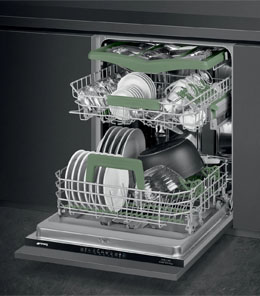
All In One Dishwasher Tablets
I know what you’re thinking. Does that mean all in one tablets can replace dishwasher salt and rinse aid?
We find this is where most of the confusion comes in. Modern dishwasher tablets often include:
- a built in water softening element
- and a rinse aid component
So in theory, they do both jobs. But in reality, they don’t always do them well enough on their own, especially in hard water areas like London.
Think of tablets as a convenient baseline. They help, but they don’t fully replace dedicated salt and rinse aid.
So, do you actually need both?
In most UK homes, yes, but for slightly different reasons. Dishwasher salt is essential in hard water areas like London because it protects the machine itself from limescale damage. Rinse aid is strongly recommended almost everywhere because it improves drying and overall finish. You can technically run a dishwasher without either, but you’re more likely to see poorer results and, over time, reduced efficiency.
FAQs: Dishwasher Salt & Rince Aid
In most cases, yes. Even if you use all in one tablets, they don’t fully replace dishwasher salt, especially in hard water areas like London. Tablets can help, but salt is still needed to protect the internal water softener and prevent limescale build up over time.
You can, but you’ll usually notice the difference. Without rinse aid, dishes are more likely to come out with water spots, streaks, or a slightly damp finish. If you don’t mind drying items by hand, it’s optional, but most people prefer the results with it.
Most modern dishwashers have indicator lights that will come on when levels are low. However, if you’re seeing cloudy glassware, white marks, or poor drying results before the lights appear, that can also be a sign your settings or levels need adjusting.
In hard water areas, limescale will gradually build up inside the machine. Over time, this can affect cleaning performance, leave residue on dishes, and potentially shorten the lifespan of the appliance. In softer water areas, the impact is less noticeable but still not ideal long term.
Yes, this is where it makes the biggest difference. Plastic doesn’t retain heat the same way glass or ceramics do, so it doesn’t dry as easily. Rinse aid helps water run off more effectively, reducing puddles and streaks on plastic containers.
You can’t really over fill salt as long as it goes into the correct reservoir, but it should only be topped up when needed. With rinse aid, overfilling or setting it too high can sometimes leave a slight film on glassware, so it’s best to adjust gradually based on results.